Notes / · 6 min
The quote is the first version of the BOM
In a quote, the estimator already decides the blank, the operations, the tool and the purchased parts - before any item exists. The cheapest big saving isn't a new tool, it's costing in the same work centres, operations and rates as the ERP.
A quote is the first, rough version of the BOM and the routing. In it, the estimator already decides the blank, the operations, the tool and the purchased parts - long before an item record exists. Yet an ERP’s standard quote costing usually doesn’t create a BOM or a routing. Once the order is won, the structure is entered again, from scratch.
So the cheapest big saving isn’t a new tool. It’s a costing built from the same building blocks as the future BOM and routing in the ERP: the same work centres, operations, rates and raw materials.
The quote process and what moves on
In automotive, quality planning (APQP) follows the quote, and its first phase produces a preliminary BOM and a preliminary process flow. That’s exactly the point where the quote should carry over into the future BOM and routing instead of being re-entered.
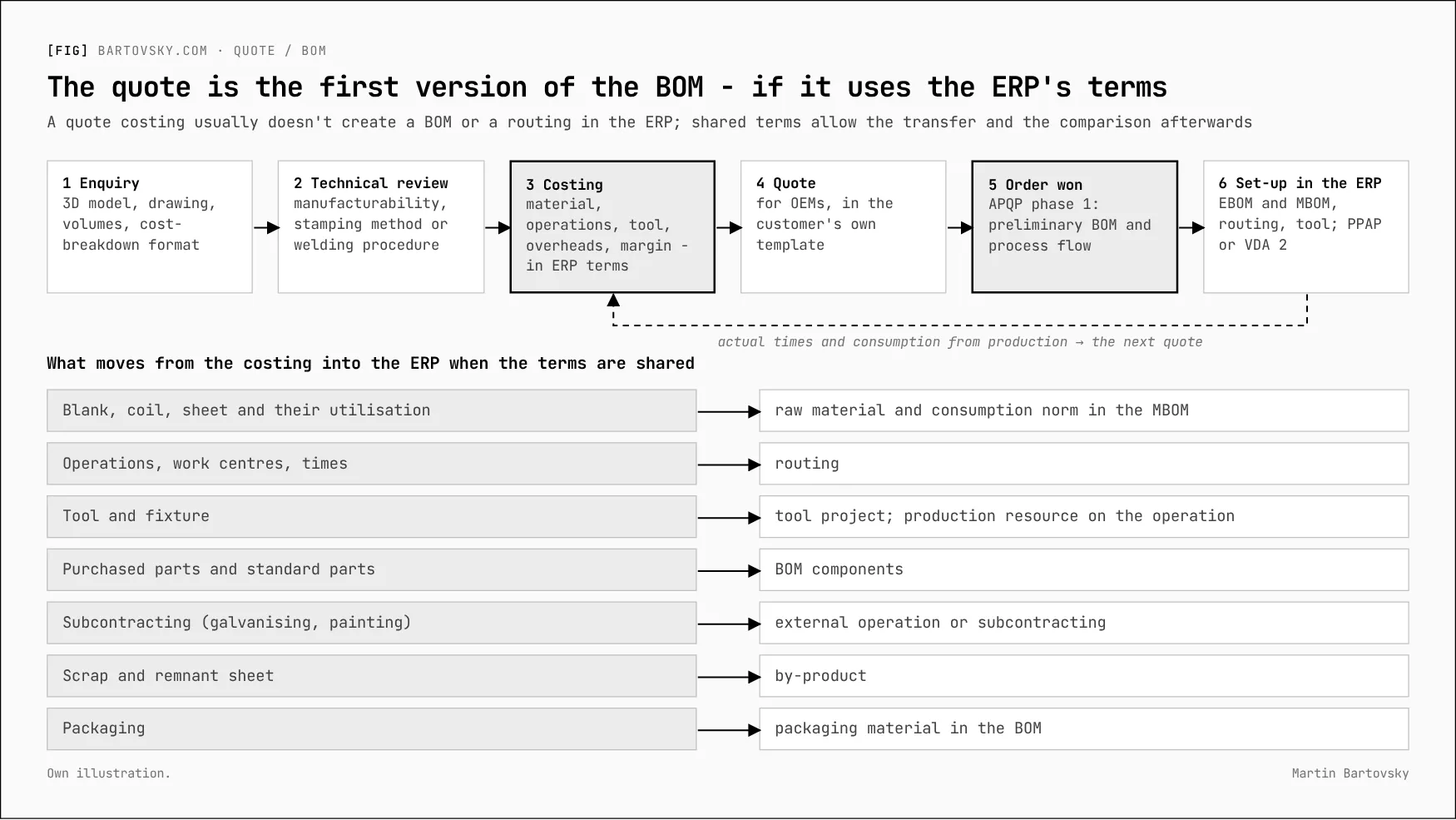
It works the other way round too: actual times and consumption from production are the best input for the next quote. Without shared terms, the two can’t even be compared.
Quote versus actual
The best feedback for an estimator is comparing the quote with what production actually used. It only works if the quote speaks the ERP’s language. An ERP compares planned and actual costs of a production order as standard - but a quote costing is a different object, so linking quote, order and part is a job for a report.
| What to compare | In the quote | Actual from the ERP | Common cause of a gap |
|---|---|---|---|
| Material | Utilisation from nesting or the blank | Issued to the order, minus by-product and scrap | Different nesting, rejects, a thickness change |
| Operation times | Costed times and rates | Confirmed times on operations | Set-up, smaller batches, another work centre |
| Tool cost | Estimate | Actuals on the tool project | Customer changes during development |
| Subcontracting (galvanising, paint) | Price from the enquiry | Subcontractor invoices | Minimum batches, transport |
| Volumes | The customer’s plan | Actual call-offs | Fixed costs spread over fewer pieces |
- Evaluate by part family, not piece by piece - single orders carry too much noise.
- The result should be corrected rates, allowances and norms in the costing tool, not a search for someone to blame.
- With OEMs the biggest gap is usually in volumes, not in technology. That belongs in the negotiation with the customer, not in the costing.
What to do
- Right away, almost for free: align the Excel costing sheets so they use the same work centres, operations, rates and raw materials as the future routings and BOMs in the ERP. Then a won quote can become a preliminary BOM without re-interpretation, and actuals can be compared with the quote.
- Stamping: a blank-and-nesting calculation from the 3D model for material; a costing add-on to the forming-simulation software only where the method engineering already uses it.
- Weldments: the quoting module of the CAM system that already runs the cutting machines. Then, depending on what customers send: finding similar past jobs (when you only get 2D drawings), or costing from 3D (when you get models).
- Quote costing in the ERP as the shared place for rates and finished quotes once the system runs - without expecting a BOM to come out of it.
- Dedicated cost-engineering platforms only when the volume of OEM enquiries and re-typing into their templates keeps more people busy.
Before deciding on any tool, these numbers are needed: enquiries per year in each segment, the hit rate, how many people estimate, which CAM runs the cutting machines, whether method engineering uses forming simulation, and in what form customers send data. Most published savings figures for quoting tools come from vendors or their customers, not from independent studies.
In SAP S/4HANA: costing in sales documents (inquiry, quotation, order), Easy Cost Planning with templates, and costing without master data. A quotation costing is transferred to the order once; a BOM or routing is not created from it.
The BOM series
- Your ERP will import BOMs from Excel. The second import is the problem.
- When does an intermediate deserve its own item number? Seven criteria
- Engineering changes: one number, revision or new part, and where-used first
- Ten tests for your BOM import before go-live
- From Excel to PLM: six levels of EBOM-to-MBOM tooling
- BOM health: the numbers that show the process still works
- The quote is the first version of the BOM (this note)
[->] next step
Where do your numbers stop adding up?
Start with a short call. Bring one report nobody trusts - I'll trace it back to where the data gets captured.