Notes / · 9 min
Engineering changes: one number, revision or new part, and where-used first
Most BOM errors aren't wrong changes - they're changes made in one product that silently apply, or don't, in others. One change number with an impact type, the form-fit-function rule, phase-out as an approved step, and a where-used list on every change.
How a BOM changes over time: who triggers a change and who carries it out, when it’s a revision and when a new part number, how a modification differs from a derived part - and why you check where a part is used before every change.
One change, one number
A proposed company rule, not an ERP feature: a change has one number, and its impact is a property of that change - E (engineering), M (manufacturing), or E+M. The impact may grow while the change is being worked on; the number stays. Two parallel number ranges, one for engineering and one for manufacturing engineering, will drift apart sooner or later.
| Type | What it changes | Typical trigger | Drawing changes? | Owner |
|---|---|---|---|---|
| Engineering (E) | What is made: shape, dimensions, material, tolerances, finish, EBOM structure | Customer (new change level), engineering, a complaint | Yes: revision or new number | Engineering |
| Manufacturing (M) | How it is made: routing, work centre, intermediates, nesting, fixture, consumption norm | Manufacturing engineering, production, purchasing | No | Manufacturing engineering |
| E+M | Both: a shape change that affects the routing, or manufacturing needs a different drawing (e.g. another bend radius) | Anyone | Yes | Engineering and manufacturing engineering, under one number |
| Temporary deviation | One order or batch only: substitute material, another work centre | Production, purchasing | No | Manufacturing engineering; for customer parts with the customer’s consent |
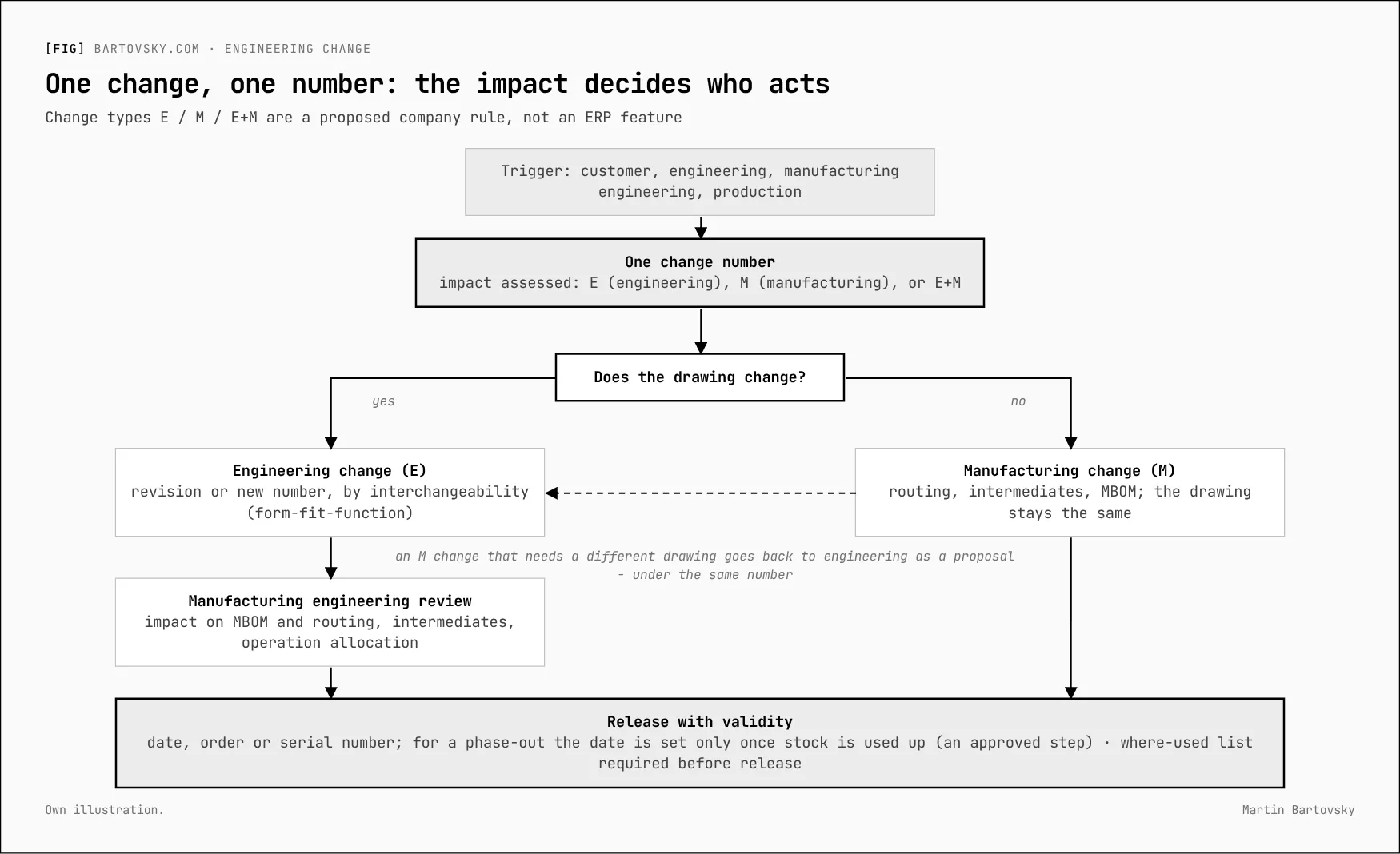
Three rules follow from it:
- A manufacturing change that needs a different drawing goes to engineering as a proposal - under the same number. The engineer accepts it, or rejects it with a reason.
- A deviation is handled on the production order, not in master data. If it keeps coming back, it’s a candidate for a permanent M or E change - not a habit.
- For parts made to a customer’s drawing (automotive, OEM supply), engineering can’t change the shape without the customer. In automotive even a manufacturing change - another line, another subcontractor - usually needs to be notified to or approved by the customer (PPAP).
Versioning: three questions that get mixed up
Is it still the same part? Which state of the model is released? From when is production switched to the new state?
| Term | Meaning | Where it lives |
|---|---|---|
| Iteration (model save) | Working state between releases | CAD only; never goes to the ERP |
| Revision (index) | Released state of the same part after an interchangeable change; the number stays | Drawing and model; in the ERP a revision of the item or document, tied to the change number |
| New part number | Non-interchangeable change; a different part | New drawing, new ERP item |
| Change number | Carries reason, impact and validity; ties together changes to item, BOM and routing | ERP change management (if the system has it; otherwise PDM or a register outside the system) |
| Validity | From when production follows the new state: date, order, serial number range | ERP, on the change number or the BOM row |
| Customer change level | An index set by the customer | A property of the part; never to be confused with your own revision |
Revision or new number: the interchangeability rule
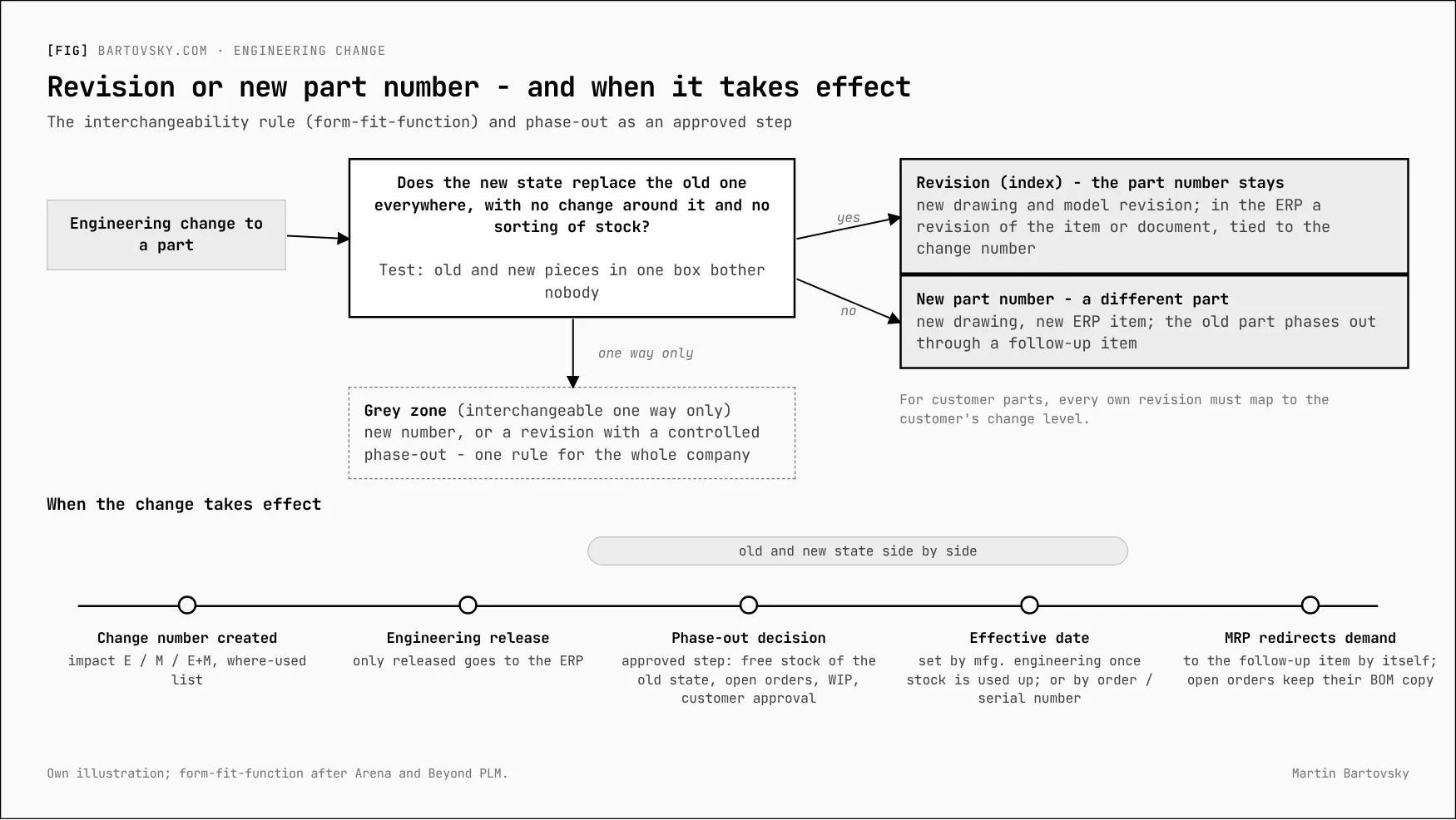
The standard is form-fit-function: if the new state replaces the old one everywhere it’s used, with no change around it and no sorting of stock, a revision is enough. Otherwise it’s a new number. The practical test: old and new pieces in one box bother nobody. In some industries (automotive) this is read more strictly, and stock has to be separated at least by batch.
Interchangeable in one direction only (the new replaces the old, not the other way round) is a grey zone. It’s solved with a new number or with a revision plus a controlled phase-out - and the rule should be one for the whole company. For customer parts, every own revision must map unambiguously to the customer’s change level.
What a change does to running production
- A production order takes a copy of the BOM and routing when it’s created - in most ERPs. A change to master data doesn’t reach orders that already exist. Who re-reads them, and when, is a process decision.
- Phase-out is not a type of validity - it’s a trigger. When no free stock of the old state is left, no open order runs on it and WIP is finished, manufacturing engineering sets the effective date. Deciding the phase-out is an approved step. Once the follow-up item and date are set in the ERP (if it supports this), MRP redirects dependent demand by itself after usable stock runs out. Open orders, customer approval and traceability are not solved by that.
- MBOM and routing must change in step, under control. A production version defines which combination is used - not a frozen content; consistency comes from change management. Explicitly versioned BOMs and routings only come with specialised manufacturing-engineering extensions or PLM (part 5).
Modification, derived part, copy
A new state of a part can come about in three ways, and each treats identity and the link to the source differently. For manufacturing engineering, what matters is whether the link survives.
| Way | What it means | Part number | Link to source | What manufacturing engineering gets |
|---|---|---|---|---|
| Modification | Interchangeable change of the same part, e.g. a radius or a hole moved within the function | Stays, new revision | Full: it’s the same part | Routing and intermediates still apply; to be checked |
| Derived part | New part created from an existing one that remembers its origin: mirror L/R, another length, another thickness | New | Kept (“derived from”) | Can reuse routing and intermediates; a change to the source flags the derived parts |
| Copy | New part with no link (“Save as”), e.g. a new product started from a similar one | New | None | Starts from scratch, or searches for a similar part by hand |
- The line between modification and derived part is the interchangeability rule above.
- CAD without PLM usually doesn’t keep “derived from”; it’s lost on “Save as”. Whoever wants it has to record it - which is why the import template has a “Derived from” column.
- A copy is the fastest option for engineering and the most expensive for manufacturing engineering. The more new products start as copies, the more it pays to insist on derived parts.
Where-used before every change
Before every engineering change, check where the part is used. The most common mistake isn’t a wrong change - it’s a change made in one product that silently applies in others, or doesn’t apply where it should.
| Where you look | What it shows | Blind spot |
|---|---|---|
| CAD (assemblies on disk) | Assemblies containing the model | Knows nothing about intermediates and MBOMs |
| ERP, engineering BOM | All parents as engineering handed them over | Doesn’t know about moves made by manufacturing engineering |
| ERP, manufacturing BOM | Actual use in production, incl. intermediates, by plant | Only what’s already in the ERP |
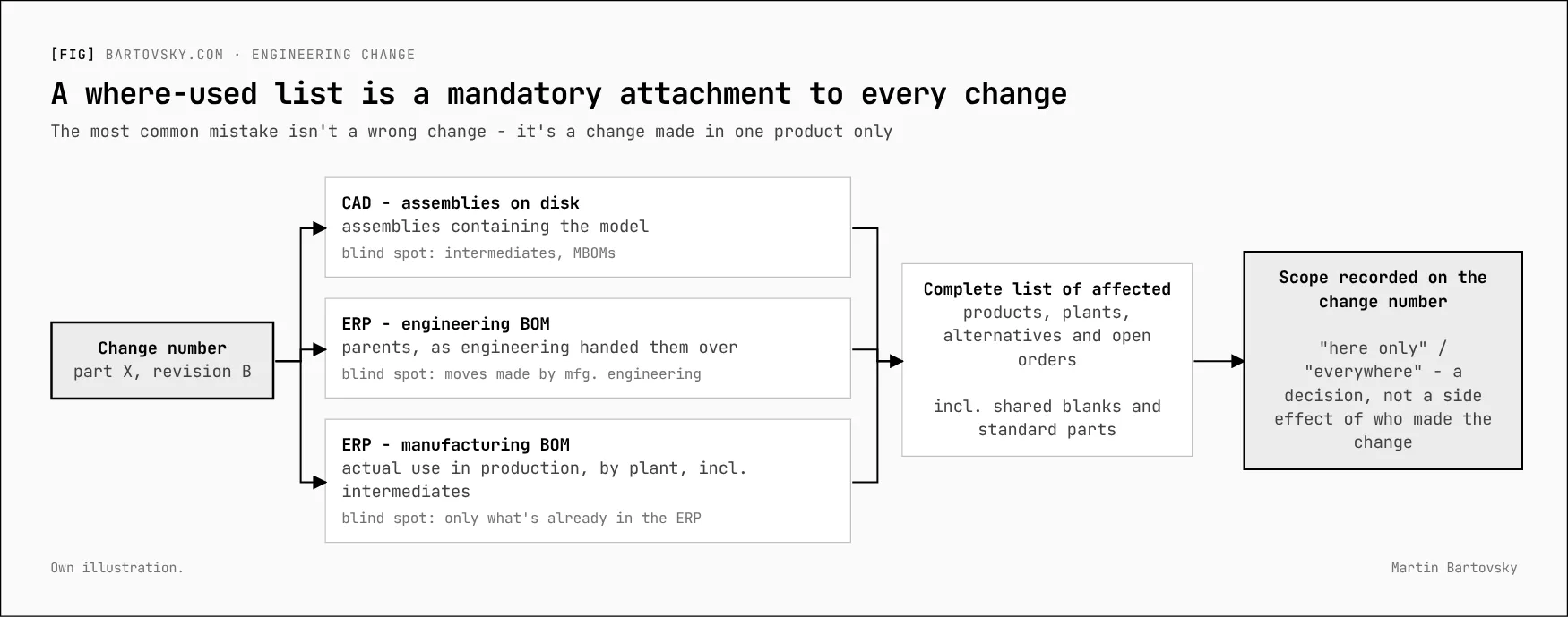
The riskiest are shared blanks, standard parts and sub-assemblies used across several product types. Every ERP has a where-used report; the question isn’t the tool, but who must use it, and when.
My proposal: a where-used list is a mandatory attachment to every change number. The scope of the change - here only, or everywhere - is a decision written on the change, not a side effect of who happened to make it.
The BOM series
- Your ERP will import BOMs from Excel. The second import is the problem.
- When does an intermediate deserve its own item number? Seven criteria
- Engineering changes: one number, revision or new part, and where-used first (this note)
- Ten tests for your BOM import before go-live
- From Excel to PLM: six levels of EBOM-to-MBOM tooling
- BOM health: the numbers that show the process still works
- The quote is the first version of the BOM
Further reading: Arena, Form-Fit-Function (FFF) Definition and Rules · Beyond PLM, Interchangeability, revisions and new part number (2021) · OpenBOM, Interchangeable Parts - New Part Number or Revision? (2019) · Arena, What is a Manufacturing Change Process?
[->] next step
Where do your numbers stop adding up?
Start with a short call. Bring one report nobody trusts - I'll trace it back to where the data gets captured.