Work / holding
Shortages and late orders, seen before the order is late
Power BI for production planners - which components will run short, which operations are already behind - and why one large "shortage" was really work in progress the ERP could not see.
- Client
- Industrial group, several companies
- Industry
- holding
- Services
- BI, Data, AI
- Stack
- Power BI, DAX, ERP data, MCP
- Period
- ongoing
Context
Planners in a manufacturing company of the group knew about shortages when an order stopped on the shop floor, and about delays when a customer called. The data to see both earlier was in the ERP; nobody had put it together.
What I do
Component shortages. Demand from production orders against stock - including the awkward case of several orders drawing on the same shared pool, where each order alone looks covered and together they aren’t.
Delays by work centre. An operation counts as late when it isn’t closed and its planned completion date has passed. The remaining work in hours is remaining quantity times standard time, plus set-up. Shown by work centre at operation level, so a planner sees where the hours pile up, not just which order is late.
Demand. Where customers send call-offs electronically, those override the sales forecast; the result is exploded through the bills of materials into a procurement plan.
AI on the model, with review. Parts of the model were built with an AI assistant working directly on the semantic model through an MCP server. Every change was reviewed; the assistant writes measures faster, it doesn’t decide what they should mean.
The finding
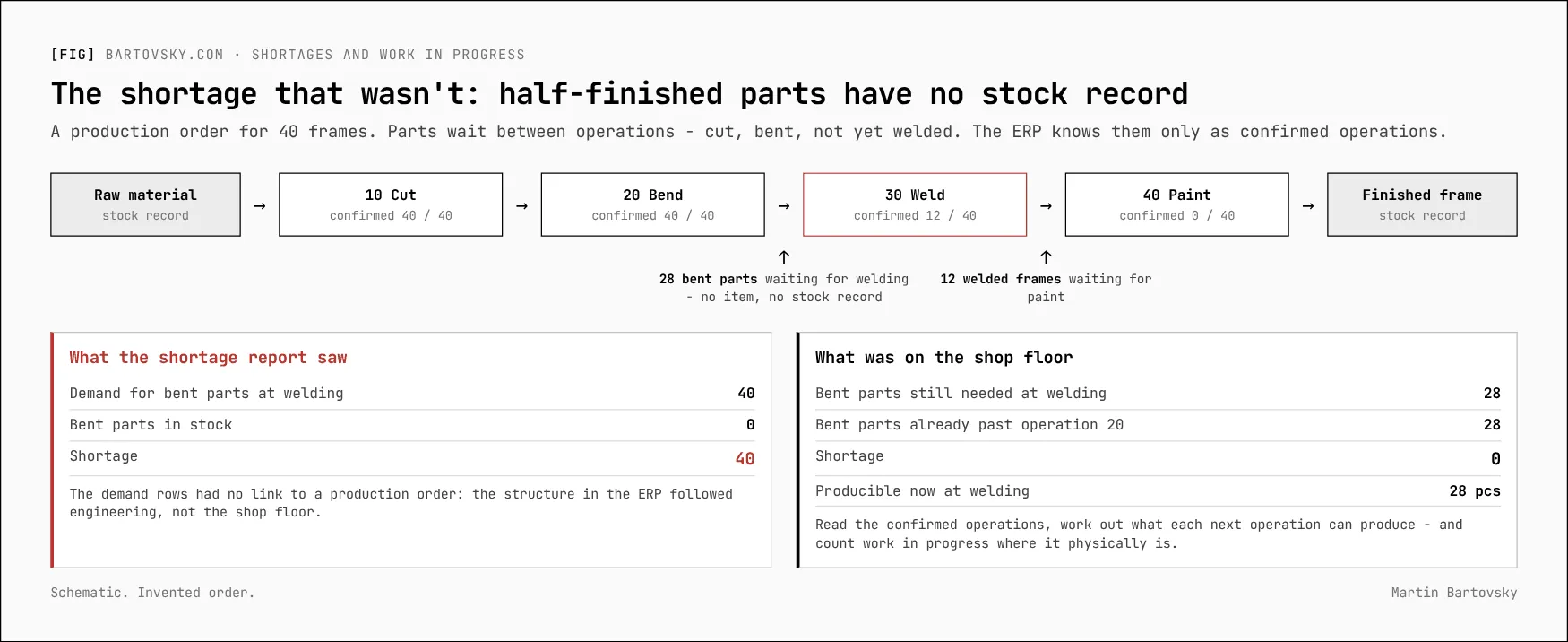
One component showed a large shortage. Roughly four fifths of its demand came from rows with no link to a production order. It looked like dirty data. It wasn’t.
The cause was in how the system was set up. The ERP held the structure as engineering sees it, not as production makes it. On the shop floor, parts wait between operations - cut but not yet bent, welded but not yet painted. That work in progress has no item and no stock record; it exists only as confirmed operations on the order. The shortage report saw the demand, but not the half-finished parts that would cover it.
I found a way to read the confirmed operations out of the system and, from them, work out what can actually be produced at the next operation. Work in progress now counts where it physically is.
Why it matters
A shortage report is only as good as the structure underneath it. When the ERP holds the engineering BOM but the factory runs on the manufacturing one, the gap shows up as false shortages - and no report design fixes that. The longer argument is in the BOM series.
[->] next step
Where do your numbers stop adding up?
Start with a short call. Bring one report nobody trusts - I'll trace it back to where the data gets captured.