Work / holding
One repository for Power BI, several suppliers
An internal team and external suppliers building reports in the same tenant. Version control owned by the client, access through groups, nothing written straight to production - now in live use.
- Client
- Industrial group, several companies
- Industry
- holding
- Services
- BI
- Stack
- Azure DevOps, Power BI, Microsoft Fabric, Microsoft Entra ID
- Period
- 2026
Context
Power BI in the group was built by a small internal team, another external supplier and me. Each worked in their own files. Which version was in production was known by whoever published last, and the history of a measure left with whoever left.
What I did
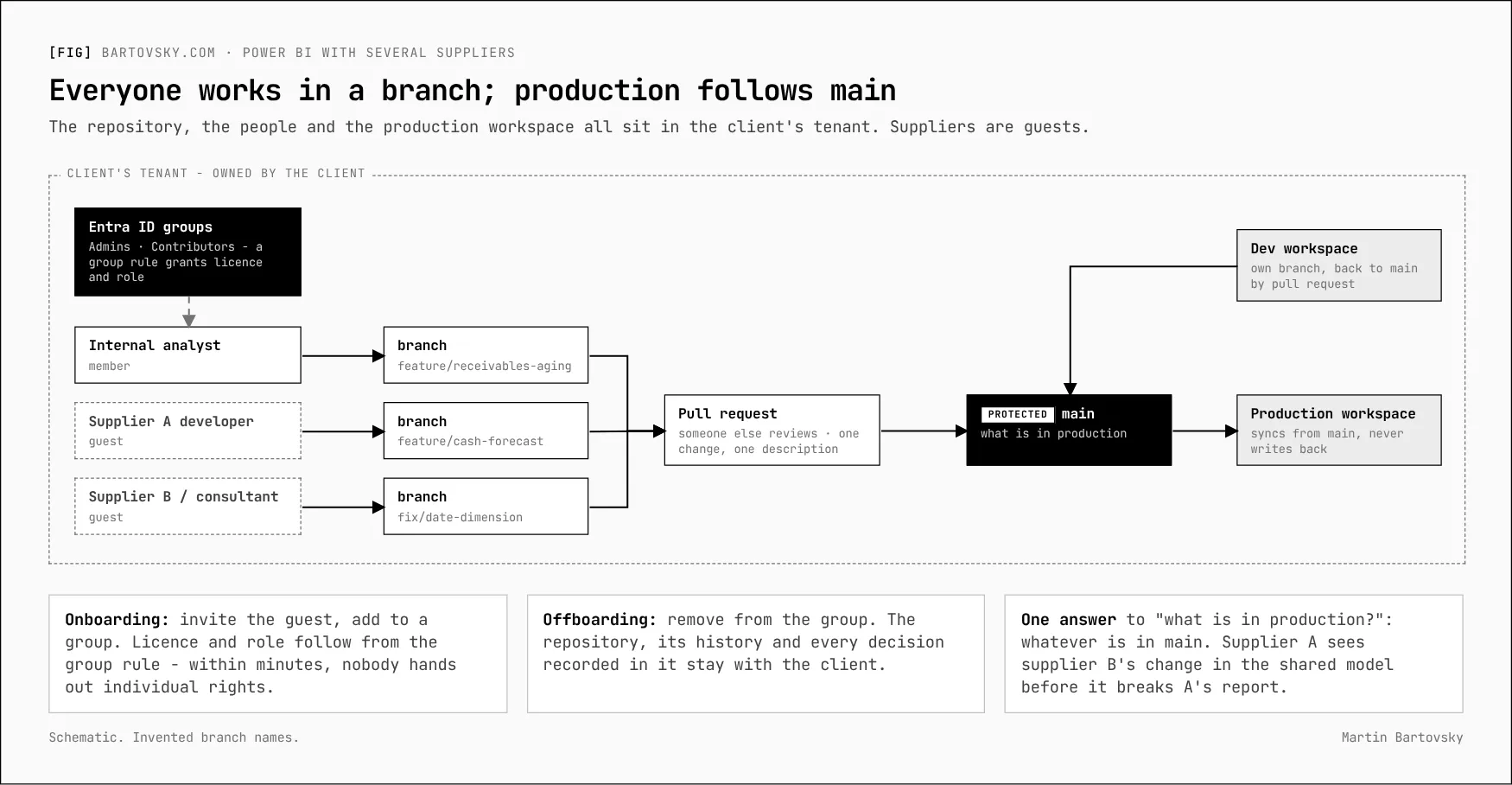
- Proposed the model: a Git repository in Azure DevOps, connected to the client’s own tenant - not the supplier’s, not mine. GitHub as the alternative.
- Access through groups: external developers join as guests; two security groups decide who administers and who contributes. On- and offboarding become an identity task anyone in the client’s IT can do.
- Production follows
main: every change through a pull request; the Fabric workspace syncs frommainand never writes to it. - Ran it myself first: the whole set-up in a lab in my own tenant - me as administrator, another account as the external guest - to answer the awkward questions before anyone depended on them.
Result
The set-up is live at the client, and the same set-up runs in my own tenant. In the lab, a guest added to the group had working access within about five minutes - without anyone handing out individual rights.
Why it matters
Version control for Power BI is an ownership decision more than a tooling one. The details are in the note on repo ownership and the step-by-step set-up.
[->] next step
Where do your numbers stop adding up?
Start with a short call. Bring one report nobody trusts - I'll trace it back to where the data gets captured.